SRE Agent Swarm — Self-Healing Infrastructure
A multi-agent system where six specialized LLM agents detect, diagnose, and remediate infrastructure incidents autonomously — coordinated over NATS JetStream with a formal incident FSM, blast-radius policy gates, and human-in-the-loop approval.
Technology Stack
Overview
SRE Agent Swarm is a self-healing infrastructure system: a swarm of specialized AI agents that continuously monitors a microservices environment, detects anomalies, reasons about root cause, proposes remediations, and — behind safety gates — executes fixes on its own. The goal was to model what a senior SRE team actually does during an incident, then decompose it into agents with distinct responsibilities and a formal lifecycle connecting them. It handles failure modes like memory leaks, CPU spikes, network partitions, and database overload, using LLM reasoning to correlate signals across metrics, logs, and traces. The repository includes a full microservices playground (ten services across Python, Go, Node.js, and Django) so the swarm has a real system to observe and repair, plus a chaos engineering harness to inject the failures it is meant to catch.
The Agent Swarm
- •Observer — Detects anomalies from metrics, logs, health checks, and synthetic probes, with deduplication and predictive detection to catch issues early.
- •Diagnoser — Pulls context from logs, traces, and deployments, then uses LLM reasoning to build a causal hypothesis for the root cause.
- •Remediator — Maps a diagnosis onto a runbook knowledge base, then selects, parameterizes, and executes actions such as restarts, rollbacks, or scaling.
- •Safety — Enforces policy, computes blast radius, rate-limits actions, and opens human approval gates for high-risk remediations.
- •Orchestrator — Owns the incident FSM, routes work between agents, manages timeouts and escalation, and builds the incident timeline.
- •Learner — Vectorizes past incidents into a store and uses RAG plus pattern recognition to recommend runbooks that previously worked on similar failures.
System Architecture
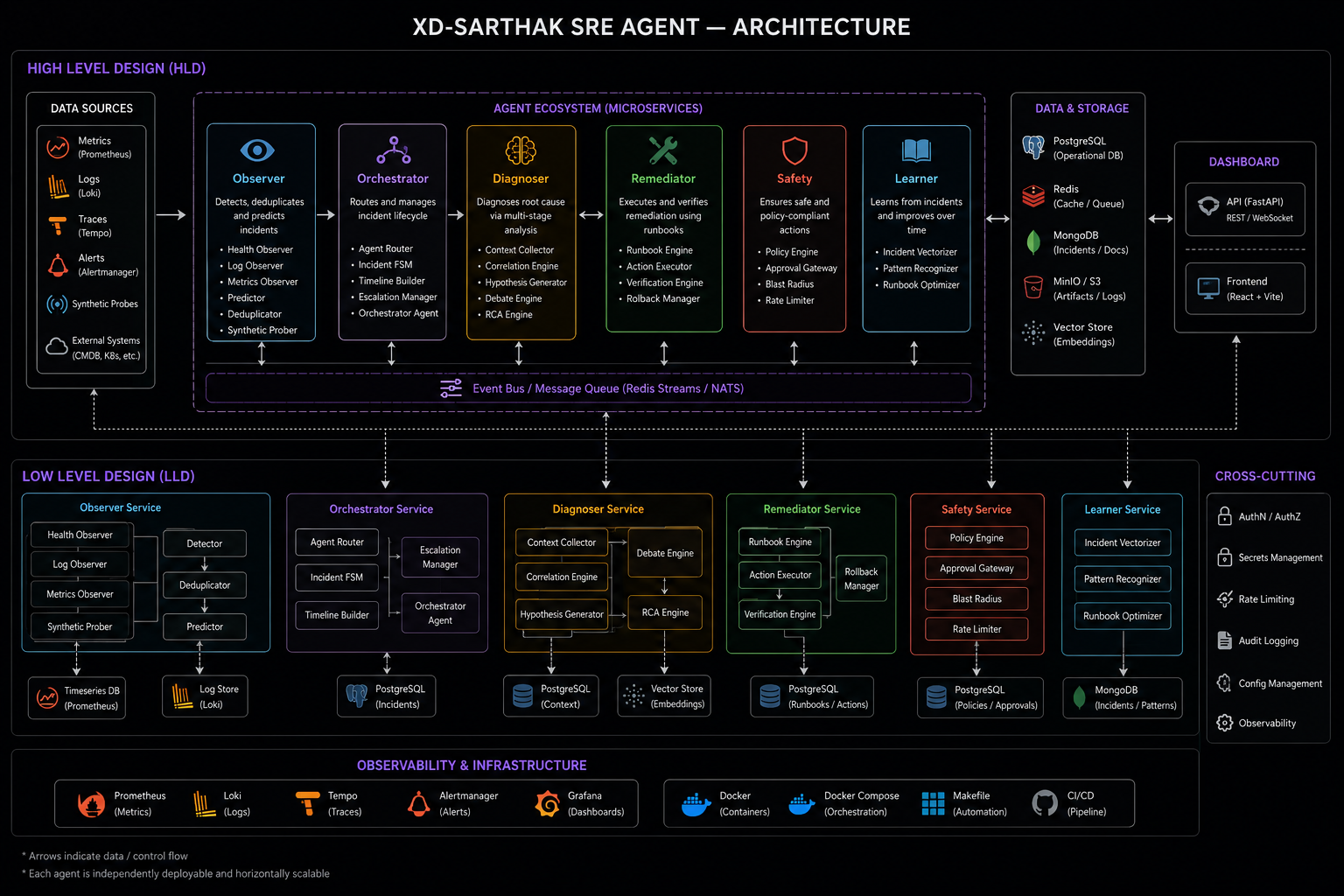
- •Messaging Layer: NATS JetStream carries a structured
AgentMessageenvelope (message ID, correlation ID keyed to the incident, source agent, payload, context) across four streams —AGENTS,INCIDENTS,HUMAN, andBUSINESS. - •Observability Layer: Prometheus for metrics, Loki for logs, Tempo for traces, and AlertManager — the signal sources the Observer draws on.
- •Persistence Layer: PostgreSQL for incident state, Redis for caching and sessions, Elasticsearch for search, and ChromaDB as the Learner's vector store.
- •Application Layer: A ten-service microservices playground behind an Nginx API gateway, spanning FastAPI, Go/Gin, Node.js, and Django.
- •Human Interface: A React dashboard backed by FastAPI for reviewing incidents, inspecting timelines, and approving gated actions.
Incident Lifecycle
Incidents move through a formal finite state machine: detecting → diagnosing → proposing_remediation → safety_review → executing → verifying → resolved → closed. The FSM includes retry loops for failed remediation and verification, a pending_human_approval state the Safety agent can force, and escalation paths when diagnosis or repair exceeds its time budget.
Key Challenges
- •Designing a message envelope and correlation scheme that keeps six independent agents coherent about a single incident.
- •Encoding "is this action safe to take automatically?" as something computable — blast radius, policy rules, and rate limits rather than a judgment call.
- •Making an autonomous remediation loop fail safe: every path through the FSM has to terminate, escalate, or hand back to a human.
- •Constraining LLM reasoning to produce hypotheses that map onto concrete, executable runbook actions.
- •Building failure injection realistic enough that the swarm's detection and diagnosis could actually be evaluated.
Key Learnings
- •Multi-agent system design — role decomposition, message-driven coordination, and avoiding a single orchestrating bottleneck.
- •Event-driven architecture with NATS JetStream, including stream design and durable consumers.
- •The full observability stack and how metrics, logs, and traces complement each other during diagnosis.
- •Modeling long-running workflows as explicit state machines instead of implicit control flow.
- •Retrieval-augmented generation applied to operational history rather than documents.
- •Human-in-the-loop design: where autonomy should stop and approval should begin.
Impact
- •Built an end-to-end autonomous incident response pipeline spanning detection, diagnosis, remediation, safety review, and learning across six agents.
- •Delivered a complete testbed — microservices playground, observability stack, and chaos scenarios for CPU spikes, memory leaks, network partitions, and database overload.
- •Backed the system with 63 test suites across the agent and service layers.